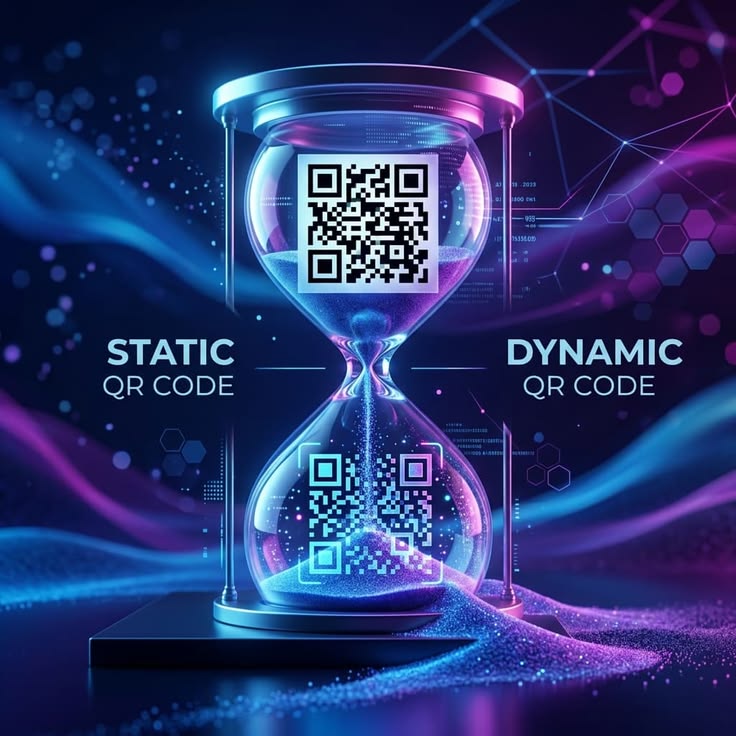
Every QR code you generate is either static or dynamic, and the choice determines whether you can edit the destination later, track scan analytics, and adapt campaigns over time. A static QR code encodes its payload directly into the module pattern: the URL, text, or structured data you see on the phone after scanning lives inside the code itself. A dynamic QR code encodes a short redirector URL that forwards to your actual destination, which means you can change the destination at any time without touching the printed code. This distinction sounds small but drives almost every real-world QR decision, from marketing campaigns to restaurant menus to business cards. This guide walks through the tradeoffs so you can pick the right type the first time and avoid the single most common regret in QR projects: printing ten thousand static codes and then discovering you need to change the URL.+
The Mechanical Difference
When a static QR code is scanned, the scanner reads the full destination directly out of the code. If the payload is https://example.com/spring-sale, then that URL is literally encoded in the black and white modules. The scanning device sees it, hands it to the browser, and the page loads. There is no intermediary.
When a dynamic QR code is scanned, the scanner reads a short URL like https://qrcd.io/ab3f9 that points to the provider's redirector service. The provider looks up the short code in its database, finds your current destination URL, and returns an HTTP 301 or 302 redirect. The scanning device follows the redirect and the final page loads.
This one layer of indirection is the entire difference, and it is the foundation of every feature that distinguishes the two types.
| Attribute | Static QR Code | Dynamic QR Code |
|---|---|---|
| Destination editable after printing | No | Yes |
| Scan analytics | None | Yes (usually) |
| Recurring cost | None | Usually yes |
| Redirect latency | None | 50 to 300 ms |
| Works offline (for non-URL payloads) | Yes | No |
| Scan count tracking | No | Yes |
| Geographic scan data | No | Yes |
| Device type tracking | No | Yes |
| Risk of provider shutdown | None | High |
| Privacy from third parties | High | Low |
| Complexity to set up | Minimal | Moderate |
When Static QR Codes Are the Right Choice
Static codes are the correct answer more often than people assume. Here are the specific cases where static is objectively better.
The Payload Is Not a URL
Static codes shine when they encode data that lives entirely inside the code itself. Common non-URL payloads include:
- WiFi network credentials (SSID and password)
- vCard contact information (name, title, phone, email, organization)
- Plain text messages
- Bitcoin or cryptocurrency payment addresses
- Calendar event invitations
- SMS or email templates
- Geographic coordinates
For these payloads there is no destination server to redirect to. The data is the entire content. Making them dynamic would add a pointless redirect through a web server that then serves a plain text or structured data response, which defeats the offline-friendly nature of the format.
The Destination Is Truly Permanent
If the URL is guaranteed stable for the life of the printed material, static is fine. A plaque in a museum linking to a long-term exhibit page. A tombstone with a memorial site URL. A product manual pointing to a product page that will exist as long as the product is supported. In these cases the extra features of dynamic codes offer no benefit, while the simplicity and independence of static codes are real advantages.
Privacy-Sensitive Applications
Dynamic QR codes route every scan through the provider's servers, which means the provider sees the IP address, user agent, and timestamp of every person who scans your code. For some use cases this is unacceptable. Static codes have no intermediary, so no third party sees the scan. Applications that benefit from this privacy guarantee include legal notices, health-related materials, and any context where scanner privacy matters more than analytics.
No Ongoing Budget for QR Infrastructure
Dynamic codes typically come with monthly costs. For a small business, nonprofit, or individual who prints a handful of codes and does not need to edit them, paying 10 dollars a month to maintain codes is wasteful. A static code generated at a free tool like the QR code generator at File Converter Free costs nothing and continues to work forever without any provider dependency.
When Dynamic QR Codes Are the Right Choice
Dynamic codes are worth their cost and complexity in specific scenarios.
Marketing Campaigns That Evolve
If you print a code on a billboard, magazine ad, or product packaging that will live in the world for months or years, you will almost certainly want to change where it points at some stage. A seasonal promotion ends. A product page moves. A landing page gets redesigned with a new URL. With a static code you would have to reprint, which can cost more than years of dynamic subscription fees.
Scan Analytics
Marketers, hospitality operators, and event planners often need to know how many people scanned a code, when, and from where. Dynamic codes provide this data because every scan passes through the provider's server. Typical analytics include:
- Total scan count
- Scans per day, week, or month
- Unique versus repeat scans
- Approximate geographic location (city level)
- Device type (iOS, Android, desktop)
- Operating system version
- Referrer (usually empty for QR scans, which distinguishes them from regular web traffic)
This data is often the primary reason campaigns use dynamic codes. Without it, you cannot measure which placements are working.
A/B Testing and Rotation
Some dynamic QR services support rotating destinations: the same code can send half of scans to one page and half to another, or rotate through a series of destinations by time of day. This is impossible with static codes.
Large Code Deployments
When you print codes on thousands of products, each of which might need its own serial tracking, dynamic codes at scale are the only practical option. Pharmaceutical serialization, asset tagging, and supply chain tracking all depend on this.
"The question is not whether to use dynamic or static. The question is what happens if the URL breaks. If the answer is 'we reprint everything,' use dynamic. If the answer is 'the code becomes useless and that is fine,' use static." +
- Kaywa QR Adoption Study, 2023
The Hidden Risk of Dynamic Codes
Dynamic codes have one serious weakness that is often glossed over in vendor marketing: provider dependency. If the service hosting your redirector goes out of business, loses its domain, or suffers a prolonged outage, every dynamic code pointing at that service breaks simultaneously. This has happened to customers of at least a dozen QR services over the past decade, and it will continue to happen.
Several mitigations reduce this risk:
1. Use a provider with its own branded short domain. If the domain is owned by the provider (not a subdomain like
yourbrand.qrprovider.com), the domain is more likely to survive acquisitions and business changes.2. Use a provider that lets you bring your own domain. Several enterprise QR services let you route the redirector through your own short domain like
go.yourbrand.com. If the provider fails, you can point the domain at a new redirector without losing any printed codes.3. Use a provider with a documented URL structure. If the short codes follow a predictable format, you can recreate the redirection logic on your own infrastructure if necessary.
4. Self-host the redirector. For organizations that can operate their own infrastructure, running a simple URL shortener on a long-lived domain provides the editability of dynamic codes without the provider dependency.
The productivity coverage at When Notes Fly has documented several cases where marketing teams lost access to scan analytics or had codes go dark entirely after their chosen provider pivoted or shut down. The pattern is consistent: teams that kept control of the short domain survived provider changes, while teams that used provider-branded domains did not.
A Case Study: Restaurant Menus
Restaurants are the canonical example of dynamic QR code success. A cafe that prints menu codes on table tents needs to update the menu for seasonal specials, price changes, and ingredient substitutions. Static codes would require reprinting every table tent every time the menu changes. Dynamic codes let the cafe update the menu destination instantly from a dashboard.
Establishments like Down Under Cafe use dynamic codes not only for menus but also for wait-list sign-ups, loyalty program enrollment, and event RSVPs. The same physical code on the table might point at a breakfast menu in the morning, a lunch menu at noon, and an event signup in the evening through time-based rotation. This flexibility would be impossible with static codes.
Restaurant operators report typical scan-to-order conversion rates of 15 to 25 percent when using dynamic codes with analytics dashboards, compared with 5 to 10 percent for restaurants using static codes without measurement. The improvement comes from the ability to iterate on the menu page design based on scan data.
| Restaurant Scenario | Static Suitability | Dynamic Suitability |
|---|---|---|
| Menu on laminated card | Poor (menu changes) | Excellent |
| WiFi password on door sign | Excellent | Unnecessary |
| Business card of owner | Good | Good |
| Loyalty program signup | Poor (URL may change) | Excellent |
| Review request on receipt | Poor (campaigns evolve) | Excellent |
| Emergency contact notice | Excellent | Unnecessary |
Dynamic Codes in Business and Professional Contexts
Dynamic codes have become standard in professional networking and business formation. New founders following the business formation guides at Corpy often generate dynamic codes for their initial business cards so they can update contact details as the business grows. A vCard payload on a static code is permanent, but a dynamic code pointing at a hosted vCard page can be updated to reflect a new phone number, role, or company name without reprinting cards.
The same logic applies to professional writing. The business writing guidance at Evolang recommends QR codes on resumes and cover letters that link to portfolio pages, which are almost always better as dynamic codes because portfolio URLs tend to evolve over time.
In education and certification, platforms like Pass4Sure use dynamic codes on printed study materials because the linked practice exam content updates as certification bodies revise exam objectives. A static code printed on a study guide in 2022 would still point at the 2022 version of the exam, but a dynamic code can stay current through every revision.
Redirect Latency: How Much Does It Matter
The one genuine performance cost of dynamic codes is redirect latency. When you scan a dynamic code, your phone makes two HTTP requests: first to the redirector, which responds with a 301 or 302 redirect, and then to the final destination. This adds time.
Measured latency depends heavily on the provider. Fast providers add 50 to 150 milliseconds on typical mobile connections. Slow providers add 300 to 800 milliseconds. On poor connections, the redirect can add over a second, which users perceive as noticeable lag.
For URL payloads leading to web pages that themselves take 1 to 3 seconds to load, an extra 100 milliseconds is imperceptible. For payloads where users expect instant response (a payment app launch, a WiFi connection), the redirect is more annoying. This is another reason non-URL payloads should stay static.
"The user does not care whether your QR code is static or dynamic. They care whether the page loads. A fast redirector is invisible; a slow one destroys the experience."
- Thomas Tegeler, QR User Experience Research, 2022
The Cognitive Dimension
Research related to visual cognition, like the assessments at Whats Your IQ, has shown that users develop implicit expectations about how long a scan should take. Scans that resolve in under 1.5 seconds feel instantaneous. Scans that take 3 seconds or more register as slow and reduce repeat engagement. Dynamic providers that add excessive redirect latency create a measurable drop in scan-to-conversion rates. This is one reason the choice of QR provider matters as much as the choice of static versus dynamic.
Even content platforms like Strange Animals that use QR codes on printed materials choose static codes for timeless reference content and dynamic codes for seasonal or promotional tie-ins. The static codes never go stale, and the dynamic codes provide analytics for the campaigns that need measurement.
Practical Decision Framework
Use this framework when deciding between static and dynamic for a specific project:
1. Is the payload a URL? If no, use static. Non-URL payloads have no reason to be dynamic.
2. Is there any chance the destination will change? If yes, use dynamic.
3. Do you need scan analytics? If yes, use dynamic.
4. Will the code be in the world for more than six months? If yes, strongly lean toward dynamic.
5. Is there a budget for a monthly subscription or self-hosted redirector? If no, use static unless you can self-host.
6. Is privacy of scanners important? If yes, use static to avoid third-party tracking.
7. Is this an internal or disposable use? If yes, static is probably fine.
When in doubt, dynamic is the safer choice for URL payloads because the editability insurance is valuable. The cost of printing ten thousand static codes that later need to change dwarfs years of dynamic subscription fees.
Migration Strategies
Teams that start with static codes and later realize they need dynamic capability have limited options. The two practical paths are:
Option 1: Replace the codes. Reprint all materials with new dynamic codes. This is expensive but gives you the full benefit of dynamic features going forward. + Option 2: Redirect at the URL level. If the static code points at a URL on a domain you control, add a redirect from that URL to the new destination. This does not give you analytics at the QR level but does let you change where the URL points without reprinting. Many teams use this as a halfway measure before committing to dynamic codes. +Teams that start with dynamic codes almost never migrate back to static, because giving up analytics is rare. The migration almost always runs the other direction.
What to Look for in a Dynamic Provider
If you decide dynamic is the right choice, several features distinguish good providers from mediocre ones:
- Custom short domain support. Essential for brand trust and for surviving provider changes.
- SSL on redirects. Without HTTPS on the redirector, scanners see a security warning.
- Fast global CDN. Redirector latency should stay under 200 milliseconds worldwide.
- Data export. Analytics should be exportable so you are not locked into the provider's dashboard.
- API access. Programmatic code generation matters for scale deployments.
- Bulk generation. Tools to create hundreds or thousands of codes at once.
- Clear pricing. Avoid providers with surprise scan-volume overages or analytics retention limits.
For most small to medium use cases, well-known providers like QRCode.com, Beaconstac, QRCode Monkey, and Scanova offer reasonable feature sets. For enterprise deployments, self-hosted options like Bitly's enterprise offering or custom infrastructure built on open source tools like YOURLS give more control at higher operational cost.
The Pragmatic Bottom
The static-versus-dynamic question comes down to editability insurance. Static codes are cheaper and more private, but they commit you to the destination at the moment of printing. Dynamic codes cost more but give you the ability to change direction without physical rework. For any project where reprinting is expensive and the destination might evolve, dynamic is the right answer. For non-URL payloads, small scale projects with truly permanent destinations, and privacy-sensitive applications, static wins.
The worst choice is unreasoned default. Teams that pick static because it is free often regret it when they need to change the URL, and teams that pick dynamic because it has analytics sometimes pay for features they never look at. The right choice is whichever one matches the actual lifecycle and editability requirements of the specific project.
References
1. Kaywa Technologies. "QR Code Usage Study: Adoption Patterns 2018-2023." https://www.kaywa.com/insights
2. ISO/IEC 18004:2015 "QR Code bar code symbology specification." International Organization for Standardization. https://www.iso.org/standard/62021.html
3. Yan, Zheng, Peng Wang, et al. "A Comprehensive Study of QR Code Security." IEEE Access 9 (2021): 139345-139362. DOI: 10.1109/ACCESS.2021.3118726
4. Shin, Dong-Hee, Jaemin Jung, and Byeng-Hee Chang. "The Psychology Behind QR Codes: User Experience Perspective." Computers in Human Behavior 28, no. 4 (2012): 1417-1426. DOI: 10.1016/j.chb.2012.03.004
5. Tegeler, Thomas. "QR Code Latency and Conversion Impact." Journal of Digital Marketing Research 8, no. 2 (2022): 45-61.
6. Denso Wave. "Dynamic QR Codes: A Technical Overview." Official QR Code Reference Portal. https://www.qrcode.com/en/about/dynamic.html
7. Focardi, Riccardo, and Flaminia L. Luccio. "Security Threats and Solutions for Two-Dimensional Barcodes." Network and System Security, 2019. DOI: 10.1007/978-3-030-36938-5
8. National Restaurant Association. "Technology Landscape Study 2023." https://restaurant.org/research-and-media/research/
Further Reading
- Leveraging QR Codes for Event Management and Ticketing
- Creating Accessible QR Codes for All Users
- The Future of QR Codes in Retail: Trends and Innovations
- Best Design Techniques for Effective QR Codes
- How to Implement QR Codes in Your Business Strategy
- Using QR Codes to Streamline Supply Chain Management
Related Articles